For decades, the “soft skills” of medicine focused on bedside manner. Today, while empathy remains paramount, technical writing has emerged as a hard clinical skill. In a system where a single misplaced comma in an EHR (Electronic Health Record) can lead to a medication error or a denied insurance claim, the ability to communicate complex data with surgical precision is no longer optional—it is a foundational competency.
The High Cost of Communication Failures
According to recent 2025 healthcare data, communication failures remain a leading cause of medical errors in the United States, contributing to an estimated $1.7 billion in malpractice costs annually (HIPAA Journal, 2026). These aren’t just verbal misunderstandings; they are often failures of documentation—ambiguous discharge instructions, poorly summarized patient histories, or technical reports that fail to bridge the gap between specialists.
This systemic pressure has reached the academic level. Pre-med and nursing students are now realizing that their scientific knowledge is only as effective as their ability to document it. Many find that mastering the nuances of academic prose is a significant hurdle; consequently, seeking professional English coursework help has become a strategic move for students to ensure their technical submissions meet the rigorous standards of modern US medical boards and university protocols.
1. The EHR Revolution and Precision Documentation
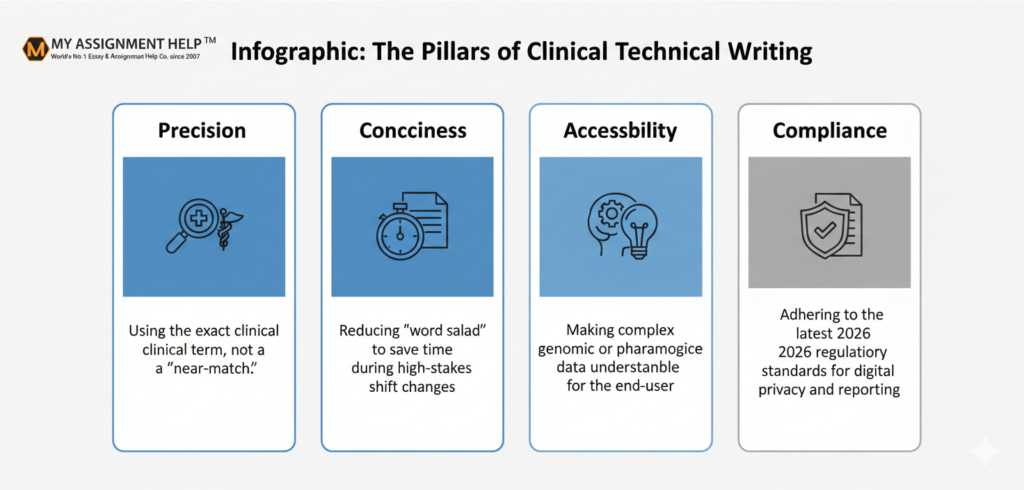
In 2026, the Electronic Health Record (EHR) is the “single source of truth.” However, “note bloat”—the practice of copy-pasting massive amounts of data into a patient’s file—has created a crisis of clarity. Technical writing skills teach clinicians how to:
- Synthesize: Extracting only relevant clinical data from a sea of lab results.
- Structure: Using standardized formats like SOAP (Subjective, Objective, Assessment, Plan) effectively.
- Standardize: Ensuring that abbreviations and terminology align with FDA and HIPAA guidelines to avoid ambiguity.
2. Bridging the Gap: From Lab to Bedside
The US biotech sector is booming, with personalized medicine and gene therapies moving from clinical trials to standard care. This transition requires clinicians who can translate highly technical “wet lab” data into “dry lab” patient education materials.
If a doctor cannot explain the mechanism of a CRISPR-based therapy in a way that a patient—or a supervising nurse—can understand, the treatment’s efficacy is at risk. This requires a unique blend of scientific literacy and technical writing. For those looking to sharpen these specific skills, exploring diverse English research topics can provide a broader perspective on how language influences scientific perception and public health policy.
3. Regulatory Compliance and The Legal Shield
In the United States, the “legal” aspect of medicine is inseparable from the “clinical.” A clinician’s notes are a legal document. Technical writing provides the “objective distance” needed to document adverse events or complex diagnoses without introducing subjective bias that could be exploited in litigation.
Key Statistic: A study by the Joint Commission found that 80% of serious medical errors involve miscommunication during patient handovers. Clear, technical documentation at the point of care is the most effective “vaccine” against these errors.
Key Takeaways for Clinical Professionals
- Clarity Equals Safety: Ambiguity in technical reports is a direct threat to patient outcomes.
- Data Integrity: Technical writing ensures that lab results and clinical observations are recorded with 100% accuracy.
- Career Advancement: In US healthcare systems, clinicians who can write grants, publish research, and lead departmental reporting are promoted faster.
- Interprofessional Collaboration: High-level writing facilitates better coordination between doctors, nurses, pharmacists, and insurance providers.
FAQs
Q: Why is English coursework important for a medical student?
A: Medical science is communicated through language. English coursework, specifically technical and scientific writing, trains the brain to organize complex thoughts into a logical hierarchy, which is essential for clinical documentation and research.
Q: Can AI replace the need for technical writing skills in healthcare?
A: While AI can help draft notes, it requires “human-in-the-loop” oversight. A clinician must have the technical writing proficiency to “audit” the AI’s output for accuracy, tone, and HIPAA compliance.
Q: How do technical writing skills impact patient satisfaction?
A: When discharge summaries and medication instructions are written clearly (lowering the “reading grade level” without losing technical accuracy), patient adherence to treatment plans increases, leading to better outcomes and higher satisfaction scores.
References
- The HIPAA Journal (2026). “Effects of Poor Communication in Healthcare – 2026 Update.”
- Bureau of Labor Statistics (2025). “Occupational Outlook for Technical Writers and Health Professionals.”
- Quality Interactions (2025). “What Actually Improved Patient Outcomes in 2025: A Communication Review.”
About the Author
Dr. Aris Thorne is a Senior Academic Strategist at MyAssignmentHelp. With over a decade of experience in medical education and technical communication, Dr. Thorne specializes in helping US-based students bridge the gap between complex scientific theory and professional-grade academic writing. He has published numerous articles on the intersection of EdTech and clinical documentation.